000 Days
00 Hours
00 Mins

Race morning until the LA Marathon!!

01 · My Journey

Diagnosis & Early History

Kevin’s story

How it started

When I was young, life threw me a curveball I never saw coming — weakness down the right side of my body. My parents were incredibly concerned, so we went straight to the doctor. After MRIs, CT scans, and more, I was wheeled into the operating room to see if I had a tumor in my brain — which I didn’t, thank God!

After all those tests, they decided I had cerebral hemiatrophy. I was eight years old. In plain English: one half of my brain is smaller than the other — “hemi” means half, and “atrophy” means that part of the brain didn’t grow or stay as large as it should. That difference on one side of the brain is what set the stage for everything that came next. A few years later? Oh man — this is where the fun begins.

A little medical history What cerebral hemiatrophy actually is — and why it set the stage

Cerebral hemiatrophy means exactly what it sounds like: one half of the brain is measurably smaller than the other. It’s not something that happens on its own — it’s almost always the downstream result of an earlier injury to that hemisphere, during a window when the brain is still developing. A perinatal stroke, a lack of oxygen around birth, an early infection, or a seizure disorder like Rasmussen’s encephalitis can all leave one side underdeveloped while the other side grows normally. The mismatch is what shows up years later on an MRI.

The condition has a name in the literature — Dyke-Davidoff-Masson syndrome — first described in 1933 by three radiologists who noticed the same pattern across a group of patients: a shrunken hemisphere, a thickened skull on that same side (the skull grows to fill the space the brain didn’t), and seizures. Before MRI existed, that triad was often the only way to even suspect it — doctors were reading skull X-rays for asymmetry, not looking directly at the brain. By the time I was diagnosed in 1998, an MRI could show it directly, in minutes, instead of inferring it from the shape of a skull.

The reason it matters for epilepsy is tissue, not symmetry. An atrophic hemisphere usually isn’t just smaller — it’s disorganized, scarred, or malformed in the exact way that makes neurons misfire and synchronize too easily. That’s the seed a seizure focus grows from. In the most severe cases — epilepsy confined to one damaged hemisphere that medication can’t touch — the surgical answer has historically been as radical as removing or disconnecting the entire hemisphere (a hemispherectomy, first attempted by Walter Dandy in 1928, later adapted for epilepsy and refined through the 20th century). My own case never needed anything that drastic — a left temporal lobectomy in 2017 took out the focus without touching the rest of the hemisphere — but the underlying asymmetry diagnosed at eight years old is the same reason that focus existed in the first place.

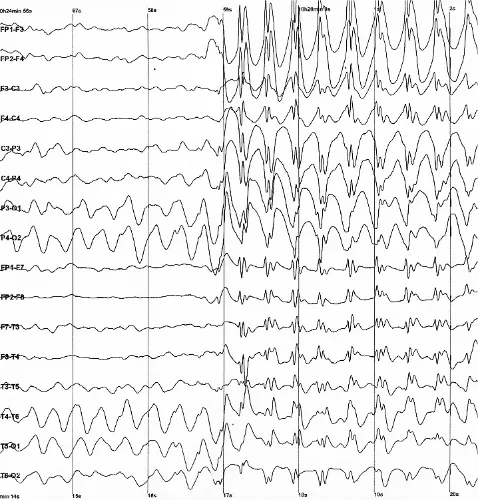
EEG spike-and-wave pattern
Electroencephalography (EEG)

The first big one

A massive seizure

I had a massive seizure — the kind that stops everything. One minute life is moving; the next, your body is gone and there’s nothing you can do about it. I ended up in the hospital for a few days to recover. Monitors. Questions. Waiting. The slow, shaky climb back to feeling like yourself again.

Those days in a hospital bed change you. You’re not just tired — you’re depleted. Your muscles ache. Your head feels wrong. People you love are scared in a way you can see on their faces even when they try to hide it. Doctors run tests and speak carefully. You start to understand that this wasn’t a fluke. Something in your brain had declared war, and recovery wasn’t overnight — it was hours and days of rest, of being watched, of wondering what comes next.

Throughout my life until I graduated high school, I was also having focal aware — or simple partial — seizures. In plain English: a focal aware seizure starts in one area of the brain, and you stay awake and aware while it’s happening — your body or senses may act up, but you’re still “there.” It might be a weird feeling, a twitch, a wave through your arm or face, something you can’t quite name. You’re present for all of it. You’re not unconscious. You’re just… interrupted.

Looking back, those moments were there for years — woven into ordinary days so tightly I treated them like nothing. A strange sensation. A brief glitch. Something I’d shrug off and keep moving. It didn’t bother me at all, because I did not know that I was having seizures. Nobody had given those episodes a name yet. To me, it was just how my body was. The massive seizure in the hospital was the thunderclap. The focal aware seizures were the quiet weather I’d been living in without realizing the storm had a label.

A little medical history The history of epilepsy

Epilepsy is one of the oldest-known conditions in medicine — described on Babylonian clay tablets over 3,000 years ago, where seizures were blamed on possession by a demon named Antasubba. For most of history, it was treated as a spiritual affliction, not a medical one. Around 400 BC, the Greek physician Hippocrates argued the opposite in his treatise On the Sacred Disease: epilepsy wasn't a curse, it was a disorder of the brain, with a physical cause like any other illness. It took over two thousand years for that view to actually win.

The stigma didn't fade with the science. Well into the 19th and 20th centuries, people with epilepsy in parts of the U.S. and Europe were barred from marrying, institutionalized, or sterilized under so-called "eugenics" laws — some of which stayed on the books until the 1970s. The actual neuroscience caught up faster: in 1873, British neurologist John Hughlings Jackson correctly described seizures as "occasional, sudden, excessive, rapid, and local discharges of grey matter" — the first real theory of what's happening at the cellular level, decades before anyone could record a brain in action.

That recording became possible in 1924, when German physiologist Hans Berger built the first human EEG — the same technology in the photo above — and used it to directly capture the abnormal electrical discharges of a seizure for the first time. From there the field moved fast: the first anti-seizure drug (phenobarbital) arrived in 1912, epilepsy surgery was refined through the mid-20th century, the VNS was FDA-approved in 1997, and DBS followed in 2018. Each device in my own story — EEG to find it, a lobectomy to remove it, a VNS and then DBS to calm it — is a direct descendant of that 2,400-year argument Hippocrates started: this is a brain disease, and brain diseases can be treated.

Seizure classification My category: generalized tonic-clonic

The International League Against Epilepsy (ILAE) classifies seizures first by where they start: focal (one area of the brain), generalized (both hemispheres from the start), or unknown onset. A generalized tonic-clonic seizure (GTC) — what used to be called a "grand mal" — is the generalized category's most dramatic form, and the one I eventually started having in community college, on top of the focal aware seizures I'd already lived with for years without a name for them.

The name describes its two phases. The tonic phase comes first: every major muscle group contracts at once and locks rigid, often causing a fall, as the discharge recruits essentially the whole cortex into one synchronized rhythm within seconds. The clonic phase follows: that rigid contraction breaks into rhythmic jerking, as inhibitory circuits fight to shut the discharge down and briefly succeed, then fail, over and over, in fast alternation — the visible tug-of-war between a seizure and the brain trying to stop it.

What makes GTC different from the focal aware seizures I'd had for years isn't just size — it's awareness. A focal aware seizure stays contained enough that I'm still "there" through it. A GTC seizure takes the brainstem and cortical arousal systems with it, so consciousness goes with the rest of the brain, and I lose the time entirely — I don't get it back, and the only honest record of it is whatever the people around me saw.

What it looks like (blurred for comfort — tap to reveal)

Community college

When everything changed

In community college I started to have generalized tonic-clonic seizures. In plain English: these are the big ones people usually picture — your whole body stiffens (tonic), then jerks (clonic), and it involves both sides of the brain. You lose awareness. It’s intense, scary, and nothing like the quieter seizures I’d had before. After seeing my neurologist in my hometown, I was still having breakthrough seizures.

What that actually meant was darker than any textbook line. Consciousness gone. Your body seized by something you can’t bargain with — locked, then thrashing, while the world keeps moving without you. You don’t get to watch it. You wake up emptied, confused, sore, sometimes injured, staring at faces that saw what you couldn’t. The quiet seizures had been a secret glitch. These were a blackout. A theft. And even after the hometown neurologist, the breakthroughs kept coming — proof that the dark wasn’t done with me yet.

After much contemplation, I decided to go down to UCLA Medical Center. UCLA’s Neurology & Neurosurgery department routinely ranks among the top 10 in the nation and #1 in Southern California. I was instantly into telemetry so the doctors could find the focal point of my seizures.

Choosing UCLA felt like stepping toward light. I wasn’t running from epilepsy anymore — I was walking into a place built to understand it. Telemetry meant answers: mapping the storm so we could finally see where it started. It wasn’t only fear; it was hope with a plan. A team skilled enough to fight for my future. A path that said my life could be more than breakthroughs and recovery beds. For the first time in a long time, the next chapter had a destination — and I believed I might get there.

Donate